
Electronic Patient Record „EPR“
German – French – Italian – Romansh – English – |› ChatGPT
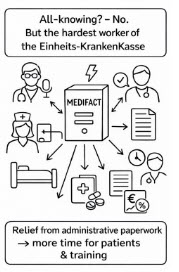 It is reassuring to know that the Electronic Patient Dossier (EPD) of the unified health insurance fund (EKK) is already, from the very beginning, well equipped with the data of the previous mandatory health insurance providers (KVG/LAMal) (see the third-last line of the initiative text of the EKK).
At the end of 2024, the Federal Council and Parliament decided to continue the existing approximately 130,000 patient dossiers under the new designation “E-GD”. This decision appears to be an obvious wrong path. These dossiers were already voluntary – and even the new “e-GD”, which will be assigned automatically to every person, can be declined. This, in our view, is precisely where the fundamental problem lies. Where, for example, could an emergency responder reliably obtain information about a blood group if no complete dossier is guaranteed? The healthcare system needs a comprehensive EPD in order to have a complete overview of a patient’s previous treatments at all times – also to prevent unnecessary duplicate services.
This is particularly important in a system with free choice of doctor. Many people suffer from illnesses that are difficult to diagnose. In the hope of finding relief, they consult one doctor after another. Each doctor often starts the examinations again from the beginning, which leads to considerable unnecessary costs. With a complete EPD, the newly treating doctor already has the necessary overview before starting treatment. Thanks to the existing reports, images, and findings, the doctor can build on existing knowledge and provide more targeted help.
Some people understandably fear that they might suffer professional or insurance disadvantages if their medical history becomes known. The EPD must strictly prevent such risks. With regard to access authorisations, progress has already been made. However, it is essential that every patient is immediately informed about every access and every new entry, for example via a personal SMS message that only the patient can read. If all parties know that every access is transparent and traceable, a large part of these fears will disappear.
The decisive advantage of the Electronic Patient Dossier of the unified health insurance fund (EKK) lies in the fact that all service providers – including private clinics and private doctors – must bill their services via the MEDIFACT system of the EKK, including in connection with privately insured patients. Only after the patient has reviewed and confirmed the content of the invoice will it be forwarded for payment to the competent payment office of the EKK or to a supplementary insurance.
Every person receives an AHV number at birth or upon immigration to Switzerland. This number also forms the central key element of the EKK. Through the uniform online billing of all service providers via MEDIFACT, all billing data – including imaging data – automatically flows into the patient dossier throughout Switzerland. This eliminates cantonal barriers and information gaps. For patients, this takes place without additional costs. However, it is in fact a highly complex infrastructure that must be continuously operated and maintained with considerable technical effort.
All services billed by service providers are accessible to authorised persons with the appropriate authorisation. At the same time, every access is fully logged. Every patient is informed in real time about who has accessed their data.
1054x
Back to the main page or to the keyword index
.