
A reader asked me the key question:
“How do you arrive at 150 francs?”
German – French – Italian – Romansh – English – ChatGPT
.This page is an excerpt from our detailed page
My answers come easily to me — I just need to take a short step back:
I received a hospital bill which — calculated on an hourly basis — was based on an hourly rate of 1,305 francs. Under the current tariff, this bill was more than six times too high. That caused major conflict, which even ended for me with a ban from the premises. 1022x
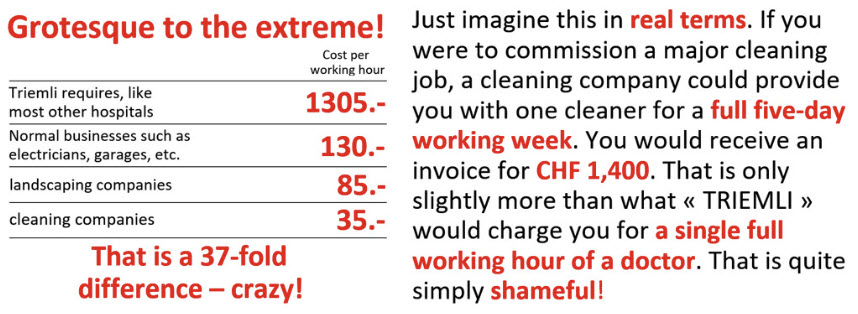
This criminal bill and the miserable behavior of the hospital director and his obedient followers were my cornerstone for designing a strong, readable federal law. Thanks to the Einheits-KrankenKasse, such wrongdoing will no longer even be possible.
Here is a comparison:
A cleaning company today charges around 35 francs per hour — that is 37 times less. 37 times less! With the same 1,305 francs, you could employ a cleaner for almost 5 working days — basically a whole week! What an extreme imbalance, what madness! Did it leave you “speechless” too?
My personal advice — check it yourself:
On your next doctor’s visit, pay close attention to the exact time when you enter the consulting room and remember what time you leave it again. When the copy of the bill arrives later, calculate what hourly rate was charged for your visit. At that moment you will feel how unfair today’s system is. Compare that rate with your own salary — you will be stunned! Even a look at the page of my Experiences with this industry will open your eyes.
Important and logical:
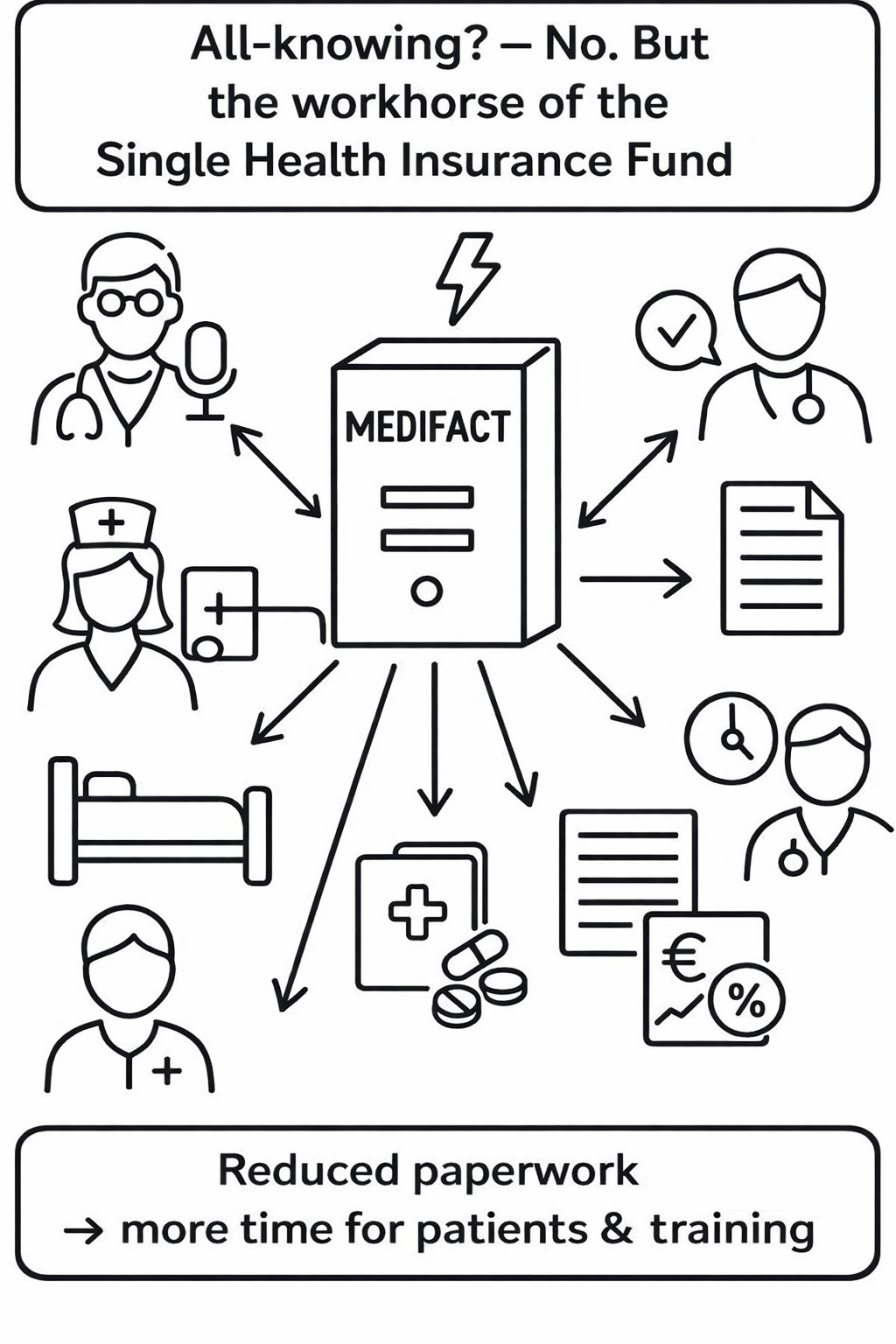 On the left you see MEDIFACT. It stands for the modern era in healthcare — and for a fundamental system change.
MEDIFACT is the new mainframe of the Einheits-KrankenKasse. It has all relevant information on treatments and operations. Only it has checked them all, stored them in the electronic patient record (EPD), and approved them for Vergütung. All medical staff are recorded there as well — including their professional background. MEDIFACT also knows all health-related data of previously treated patients.
Believe me: no human being could recognize so many connections within fractions of a second. Based on that, it can make objective, fact-based decisions.
Today: doctors and nursing staff spend more than half of their working time producing surgical reports, nursing reports, and other tasks — still necessary today.
Later with the EKK: during working hours, patient-facing staff will wear newly developed personal EKK trackers. These record when, where, and how long staff are with a patient. This is always the basis for every Vergütung by the EKK. Without a tracker, no Vergütung is generated.
The trackers also record conversations, which MEDIFACT needs as the basis for automated processing. Even long conversations, e.g. during shift handovers, become shorter because MEDIFACT can whisper the right information into staff members’ ears, depending on where they are.
At the end of the day or the end of treatment, the tracker “recovers” on its charging station and transmits what it captured to MEDIFACT at the same time.
MEDIFACT separates relevant from irrelevant content and deletes the latter. It informs patients in their language, obtains their confirmation, issues payment instructions, and stores everything important in the patient record. This list is far from complete. MEDIFACT can do much, much more!
Because staff no longer need to deal with administrative work — except for unavoidable screen inputs — much more surgical and nursing time becomes available, which also increases Vergütungen to more than double.
Officially, the medical tariff TARMED applies.
Its position 00.0010 allows 200 francs per doctor-hour. Anything above that cannot be justified objectively unless it is an outstanding top performance. The 1,305 francs charged to me — note: for a simple, standard final check (0/8/15), without even touching the patient — did not qualify. The bill was therefore more than six times higher than what is permitted by the tariff. If hospital directors billed the work of their good doctors and nurses correctly at 200 francs per hour, then by analogy my insurance premium of 505 francs would also have to be more than six times lower — i.e. at around 80 francs. Because the Einheits-KrankenKasse will offer far more than is customary today, a single uniform monthly premium of 150 francs is justified both factually and mathematically.
That is my answer to the question above: that’s exactly why 150 francs is right!
The difference between 80 and 150 francs — i.e. 70 francs — is used by the EKK as follows:
➤ You keep more of your earned salary in your wallet because the payroll deduction for “non-occupational accident” is history.
.
 ➤ Zero francs of premium money for children up to the age of 18. Today, a family with two children in Zurich pays at least 1,300 francs per month — and that is only if none of you has to see a doctor. If you do, additional out-of-pocket amounts apply. With the Einheits-KrankenKasse you therefore save an incredible 12,000 francs per year. Have you already thought about where you could travel on vacation with your children?
➤ No more out-of-pocket amounts.
➤ Dentist free of charge — except dental cleaning and medically not indicated dental replacements.
➤ Free choice of doctor, except in hospitals.
➤ Free patient transport.
➤ Doctor-prescribed medicines that are not available here and that you import yourself are reimbursed via Vergütung.
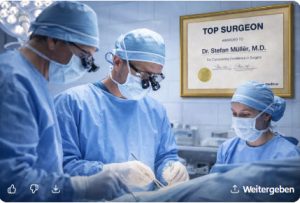 ➤ New — and this gives you special peace of mind: only the most experienced surgeons, specialized precisely in your potentially diseased organ, will be able to operate on you — with no significant waiting time! Even people with supplementary insurance cannot always enjoy such advantages. In this respect — we are heading toward a wonderful future.
Interesting:
Please read my assignment to ChatGPT and its answer, which it gave me — together — with the image beside it.